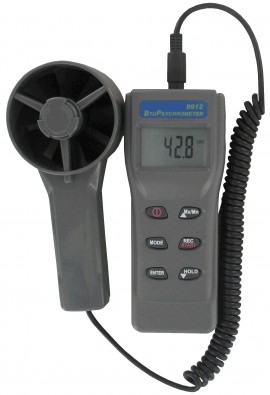
Dwyer 8912 Vane Thermo-Anemometer

Model: 8912 | Order No: 8912/A

Dwyer 8912 Vane Thermo-Anemometer

Model: 8912 | Order No: 8912/A

Can measure air velocity, air volume, temperature, humidity, and BTU.

Can measure air velocity, air volume, temperature, humidity, and BTU.

Discontinued!

This product has been discontinued and is no longer available.
This is the direct replacement:

Dwyer 473B-1 Vane Thermo-Anemometer, 100 mm -

Dwyer 473B-1 Vane Thermo-Anemometer, 100 mm

Model: 473B-1

Measure air velocity or volumetric air flow quickly and easily. Also measures air temperature and humidity in imperial or metric units. Includes a 100mm diameter stainless steel vane probe. Able to store 99 measurements.


Dwyer 8912 Offers

User-selectable wind speed units include ft/min, m/s, knots, mph and km/hr. In addition to these functions, the 9671 is capable of measuring relative humidity, wet bulb temperature, dew point and BTU capacity. A built-in sensor records ambient temperature in °F or °C.

Features

  • Data hold
  • Record minimum, maximum, and average readings
  • 1.8" (45 mm) display
  • Detachable probe for easy replacement

Applications

  • HVAC/R inspection
  • Energy Audits
  • Balancing Applications


Anemometers are instruments used to measure wind speed or air velocity in meteorology and aerodynamics. The name is derived from the Greek root Anemos, meaning wind. There are many anemometer sensor types with one of the most popular being thermo, or hot-wire, anemometers for HVAC/R air velocity monitoring. Thermo-anemometers use a sensor element that is heated up beyond the ambient temperature. Airflow moving past the sensor will have a cooling effect that is directly proportional to the flow velocity.

Hot wire anemometers come in three basic types: constant current, constant voltage, and constant temperature. All three types have circuits that are based on trying to maintain a specific variable during the cooling effect based on Ohm's Law. Thermo-anemometers offer good low flow detection, fast response times, and high rangeability of measurements. They are omni-directional, making them good for turbulent flows and easier to use than pitot tubes, but are more fragile than pitot tubes.
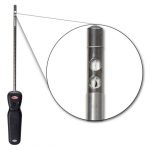
Usually, a probe style sensor is made for insertion into ducts and pipes. For constant temperature thermo-anemometers, two temperature sensors are installed at the end of the probe, typically resistance temperature detectors (RTDs). One RTD measures the ambient temperature as a reference. The second RTD is continuously maintained at a constant temperature above ambient. The higher the air velocity, the more current is required to maintain the second RTD's temperature. Based on the current usage, the air velocity is calculated.

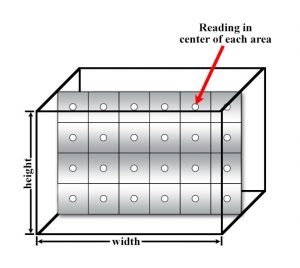
Like a pitot tube, thermo-anemometers are a single point sensing device that requires being in the center of the velocity profile or the use of traverse readings for accurate measurements.
Dwyer 8912 Specifications

Display 1 x 1.8" (26 x 45 mm)
Serial Communications 9600 bps, 8 data bits, no parity
Power Requirements 4 x AAA alkaline batteries, user replaceable
Battery Life 100 hours
Vane Diameter 3" (77 mm)
Weight 6 oz (170 g)
Agency Approvals CE
Click here for complete specifications on the Dwyer 8912

What's included with the Dwyer 8912

  • Vane Thermo-Anemometer
  • Hard carrying case
  • 4 x AAA batteries
  • Instruction manual

Dwyer 8912 Offers

User-selectable wind speed units include ft/min, m/s, knots, mph and km/hr. In addition to these functions, the 9671 is capable of measuring relative humidity, wet bulb temperature, dew point and BTU capacity. A built-in sensor records ambient temperature in °F or °C.

Features

  • Data hold
  • Record minimum, maximum, and average readings
  • 1.8" (45 mm) display
  • Detachable probe for easy replacement

Applications

  • HVAC/R inspection
  • Energy Audits
  • Balancing Applications


Anemometers are instruments used to measure wind speed or air velocity in meteorology and aerodynamics. The name is derived from the Greek root Anemos, meaning wind. There are many anemometer sensor types with one of the most popular being thermo, or hot-wire, anemometers for HVAC/R air velocity monitoring. Thermo-anemometers use a sensor element that is heated up beyond the ambient temperature. Airflow moving past the sensor will have a cooling effect that is directly proportional to the flow velocity.

Hot wire anemometers come in three basic types: constant current, constant voltage, and constant temperature. All three types have circuits that are based on trying to maintain a specific variable during the cooling effect based on Ohm's Law. Thermo-anemometers offer good low flow detection, fast response times, and high rangeability of measurements. They are omni-directional, making them good for turbulent flows and easier to use than pitot tubes, but are more fragile than pitot tubes.

Usually, a probe style sensor is made for insertion into ducts and pipes. For constant temperature thermo-anemometers, two temperature sensors are installed at the end of the probe, typically resistance temperature detectors (RTDs). One RTD measures the ambient temperature as a reference. The second RTD is continuously maintained at a constant temperature above ambient. The higher the air velocity, the more current is required to maintain the second RTD's temperature. Based on the current usage, the air velocity is calculated.

Like a pitot tube, thermo-anemometers are a single point sensing device that requires being in the center of the velocity profile or the use of traverse readings for accurate measurements.

Dwyer 8912 Specifications

Display 1 x 1.8" (26 x 45 mm)
Serial Communications 9600 bps, 8 data bits, no parity
Power Requirements 4 x AAA alkaline batteries, user replaceable
Battery Life 100 hours
Vane Diameter 3" (77 mm)
Weight 6 oz (170 g)
Agency Approvals CE
Click here for complete specifications on the Dwyer 8912

What's included with the Dwyer 8912

  • Vane Thermo-Anemometer
  • Hard carrying case
  • 4 x AAA batteries
  • Instruction manual

More Dwyer Products