"Our job is helping you do your job"

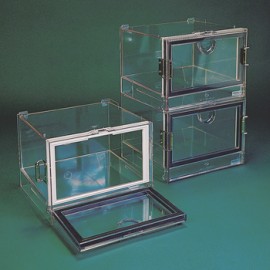
The door seals against a foam rubber gasket and is held closed with two roller latches. The open door glides underneath the cabinet to maintain the cabinet's small footprint. Dimensions: 21 x 18 x 13cm (81/4 x 7 x 5") I.D. Door opening 19 x 11cm (71/2 x 43/8"). A jar of silica gel desiccant is included. Ideal for use with Scienceware® desiccant cartridges or canisters. Per each
A desiccator is an economical and reliable way to provide dry, dust-free organization and storage for moisture-sensitive products such as reagents or valuable electronic components.
Proper storage conditions can be optimized by selecting a desiccator with the size, style and control mechanism that best suit your application, your space requirements and the items being stored.
Frequently asked questions:

There are four (4) basic types of desiccators: standard, automatic, gas purge and vacuum.
Here is an overview of the advantages and disadvantages of each.
| Method | Advantages | Disadvantages |
|---|---|---|
| Method Standard | Advantages Economical; flexible; portable | Disadvantages Requires monitoring |
| Method Automatic | Advantages Desiccant continuously regenerated; minimal monitoring; precise control | Disadvantages Typically more expensive than standard desiccators |
| Method Gas Purge | Advantages Faster to reach the target humidity level; dust-free; creates very dry environments | Disadvantages Requires access to an inert gas (such as argon or nitrogen) |
| Method Vacuum | Advantages Ideal for completely dry storage; can also be used for degassing techniques | Disadvantages Requires access to a vacuum pump; vacuum hold time may vary from model to model |
| Standard desiccant | Automatic desiccant regeneration | Gas purge | Vacuum |
|---|---|---|---|
| Manually monitored and operated. Moisture is absorbed from the air inside the unit using a desiccant pouch. Once the desiccant is saturated, it must be regenerated by heating or replaced. | Electric fans and heaters continuously regenerate the desiccant to prevent it from becoming saturated and to automatically maintain a low-humidity environment. | A slow, steady flow of inert gas (often dry nitrogen) is supplied | Air and moisture are drawn out of the chamber by the action of a vacuum pump. |
| Accommodates any type of desiccant (silica gel beads, activated charcoal, etc.) based on economy and convenience. | Convenience; requires only minimal monitoring. | Much faster to reach the desired relative humidity level. | Ideal for completely dry storage, or where air could be damaging to the stored material. |
| Portability. | Precise humidity control. Operates on a set schedule of desiccation followed by a regeneration period. | Dust-free, desirable for many applications including cleanrooms. | Dust-free, desirable for many applications including cleanrooms. |
| Economical operation. Most desiccants can be regenerated periodically. | The process uses silica gel beads that last for thousands of regeneration cycles. | Stopcocks can be closed and the unit used with standard desiccants. | Stopcocks can be closed and the unit used with standard desiccants. |
First determine which method of desiccation best suits your needs. Each method has its own particular advantages and disadvantages.
Standard desiccators typically use desiccant cartridges and are economical to operate, but they require monitoring so that the cartridges can be changed as needed to continuously maintain a dry environment.
Automatic desiccators regenerate the desiccant as needed and require minimal monitoring, with no concern about compromising samples, but they are generally more expensive than standard desiccators.
Vacuum desiccators draw out air and moisture using a vacuum pump or an in-house laboratory vacuum, and can easily be returned to vacuum after being opened. Vacuum desiccators can also be used for degassing techniques. Vacuum hold time may vary from model to model.
Gas purge desiccators are available for desiccation with gases such as argon and nitrogen to achieve ultra-dry environments.

Determine the size of the items you need to store and in what quantities. The location where the desiccator will be placed, the interior volume and the shelving options should all be taken into account. Both round style and cabinet style desiccators are available in sizes ranging from fairly small to very large.
Round style desiccators generally feature one (1) shelf and a domed top to provide additional vertical space.
Cabinet style desiccators tend to offer better accessibility and greater storage capacity, and can also provide stacking capability to save exterior space. They often have multiple shelves, in most cases adjustable to suit your needs.
Traditionally, vacuum desiccators were only available in the round style, because square shapes are prone to implosion under vacuum.
Lab Companion desiccators, however, have solved this problem; they are vacuum-resistant, and so they offer the benefits of vacuum desiccation along with the ability to store more items, with easier access and in less space.
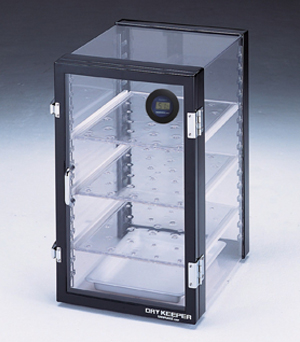
Cabinet Style Desiccator
A desiccator is an economical and reliable way to provide dry, dust-free organization and storage for moisture-sensitive products such as reagents or valuable electronic components.
Proper storage conditions can be optimized by selecting a desiccator with the size, style and control mechanism that best suit your application, your space requirements and the items being stored.
Frequently asked questions:
There are four (4) basic types of desiccators: standard, automatic, gas purge and vacuum.
Here is an overview of the advantages and disadvantages of each.
| Method | Advantages | Disadvantages |
|---|---|---|
| Method Standard | Advantages Economical; flexible; portable | Disadvantages Requires monitoring |
| Method Automatic | Advantages Desiccant continuously regenerated; minimal monitoring; precise control | Disadvantages Typically more expensive than standard desiccators |
| Method Gas Purge | Advantages Faster to reach the target humidity level; dust-free; creates very dry environments | Disadvantages Requires access to an inert gas (such as argon or nitrogen) |
| Method Vacuum | Advantages Ideal for completely dry storage; can also be used for degassing techniques | Disadvantages Requires access to a vacuum pump; vacuum hold time may vary from model to model |
| Standard desiccant | Automatic desiccant regeneration | Gas purge | Vacuum |
|---|---|---|---|
| Manually monitored and operated. Moisture is absorbed from the air inside the unit using a desiccant pouch. Once the desiccant is saturated, it must be regenerated by heating or replaced. | Electric fans and heaters continuously regenerate the desiccant to prevent it from becoming saturated and to automatically maintain a low-humidity environment. | A slow, steady flow of inert gas (often dry nitrogen) is supplied | Air and moisture are drawn out of the chamber by the action of a vacuum pump. |
| Accommodates any type of desiccant (silica gel beads, activated charcoal, etc.) based on economy and convenience. | Convenience; requires only minimal monitoring. | Much faster to reach the desired relative humidity level. | Ideal for completely dry storage, or where air could be damaging to the stored material. |
| Portability. | Precise humidity control. Operates on a set schedule of desiccation followed by a regeneration period. | Dust-free, desirable for many applications including cleanrooms. | Dust-free, desirable for many applications including cleanrooms. |
| Economical operation. Most desiccants can be regenerated periodically. | The process uses silica gel beads that last for thousands of regeneration cycles. | Stopcocks can be closed and the unit used with standard desiccants. | Stopcocks can be closed and the unit used with standard desiccants. |
First determine which method of desiccation best suits your needs. Each method has its own particular advantages and disadvantages.
Standard desiccators typically use desiccant cartridges and are economical to operate, but they require monitoring so that the cartridges can be changed as needed to continuously maintain a dry environment.
Automatic desiccators regenerate the desiccant as needed and require minimal monitoring, with no concern about compromising samples, but they are generally more expensive than standard desiccators.
Vacuum desiccators draw out air and moisture using a vacuum pump or an in-house laboratory vacuum, and can easily be returned to vacuum after being opened. Vacuum desiccators can also be used for degassing techniques. Vacuum hold time may vary from model to model.
Gas purge desiccators are available for desiccation with gases such as argon and nitrogen to achieve ultra-dry environments.
Determine the size of the items you need to store and in what quantities. The location where the desiccator will be placed, the interior volume and the shelving options should all be taken into account. Both round style and cabinet style desiccators are available in sizes ranging from fairly small to very large.
Round style desiccators generally feature one (1) shelf and a domed top to provide additional vertical space.
Cabinet style desiccators tend to offer better accessibility and greater storage capacity, and can also provide stacking capability to save exterior space. They often have multiple shelves, in most cases adjustable to suit your needs.
Traditionally, vacuum desiccators were only available in the round style, because square shapes are prone to implosion under vacuum.
Lab Companion desiccators, however, have solved this problem; they are vacuum-resistant, and so they offer the benefits of vacuum desiccation along with the ability to store more items, with easier access and in less space.
Cabinet Style Desiccator